FourKites AI Product

Design Direction

AI/ML

SaaS

Supply Chain

Design Systems

Data Visualzation
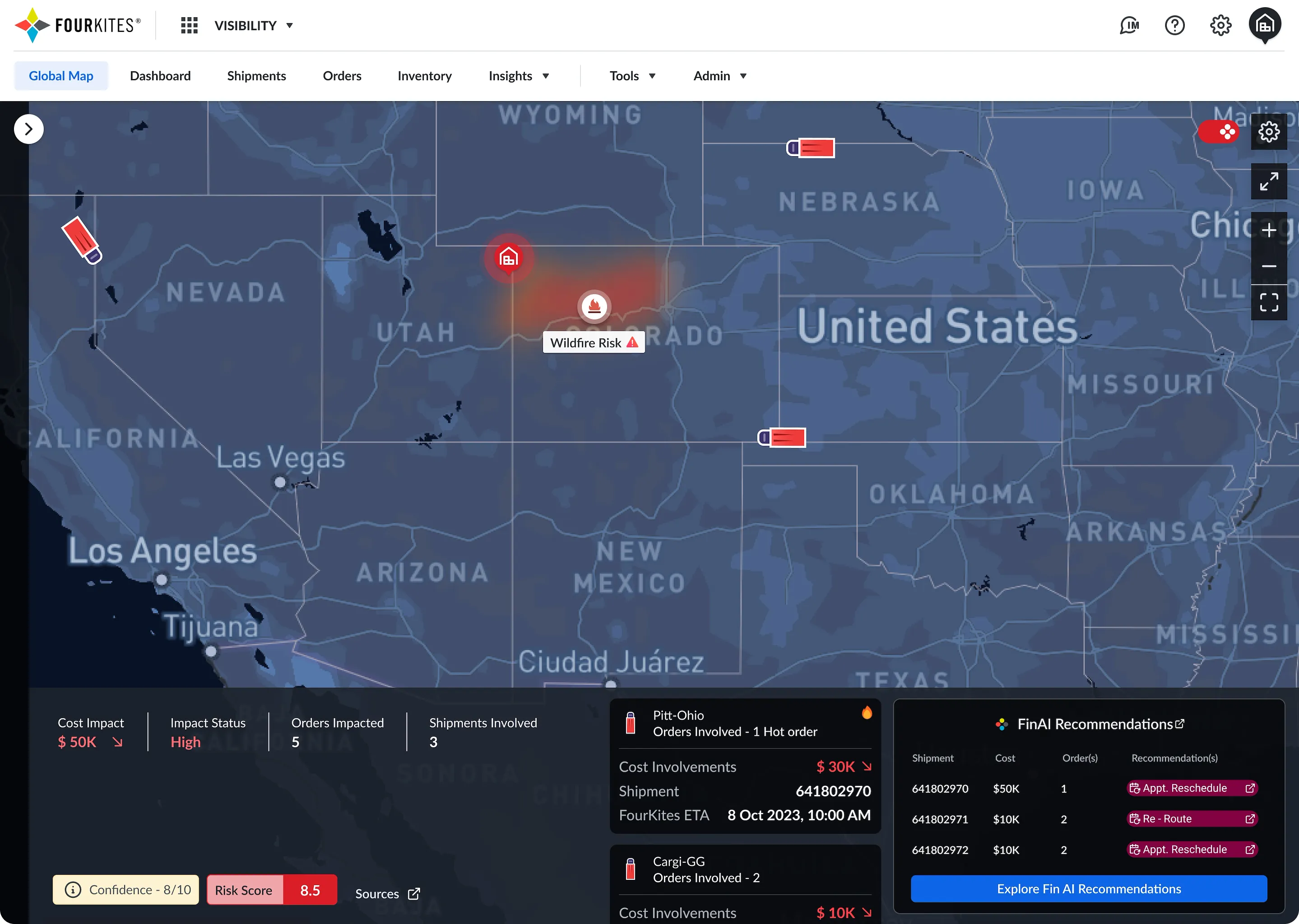
FourKites AI platform showing a conversational logistics interface with shipment monitoring, maps, and AI-assisted investigation tools.

Overview

Supply chain operators needed a faster way to investigate shipment disruptions without sacrificing trust in AI-generated recommendations. I led the interaction design for FourKites' first conversational AI experience, defining when AI could act autonomously and when human review was required.

My belief was simple: for high stakes decisions, an AI system earns trust by asking permission, not by acting first and explaining later.

Challenge

FourKites operators were navigating dense, high-stakes shipment data across multiple systems, often under time pressure when something was already going wrong. A purely automated system risked acting on bad data or false confidence. A purely manual one couldn't scale. We needed an interaction model where AI could trigger real actions, like flagging exceptions or surfacing risk, while keeping a human checkpoint for anything an operator needed to trust before it shipped.

Approach

I defined the human-in-the-loop interaction model that determined which AI-generated actions could execute automatically and which required operator approval. Working alongside product, engineering, and data science, I established review patterns, confidence thresholds, and conversational workflows that allowed operators to approve, reject, or investigate recommendations without losing context. Rather than designing a generic chatbot, we built an AI experience grounded in the language, workflows, and decision models operators already trusted.

Approach

Outcome

I defined the human-in-the-loop interaction model that determined which AI-generated actions could execute automatically and which required operator approval. Working alongside product, engineering, and data science, I established review patterns, confidence thresholds, and conversational workflows that allowed operators to approve, reject, or investigate recommendations without losing context. Rather than designing a generic chatbot, we built an AI experience grounded in the language, workflows, and decision models operators already trusted.

We considered fully automating shipment exception handling, but rejected it because operators would not trust silent AI decisions on high stakes freight. We chose a checkpoint model instead, where the AI recommends and the operator approves, trading some speed for trust we could not afford to lose.

Outcome

KiteBot (Later FinAI) launched as the first integrated AI experience within the FourKites platform, marking the company’s entry into intelligent automation for supply-chain visibility. The direction and framework defined during Phase 1 established a blueprint for future releases -laying the foundation for predictive AI features, richer analytics, and a scalable conversational design system that could expand across the broader FourKites product ecosystem.

50% increase in subscribed-user retention.

50% increase in subscribed-user retention.

42% faster shipment exception resolution (1 hour → 35 minutes).

42% faster shipment exception resolution (1 hour → 35 minutes).


70% weekly adoption after 90 days among operators using the AI workflow.

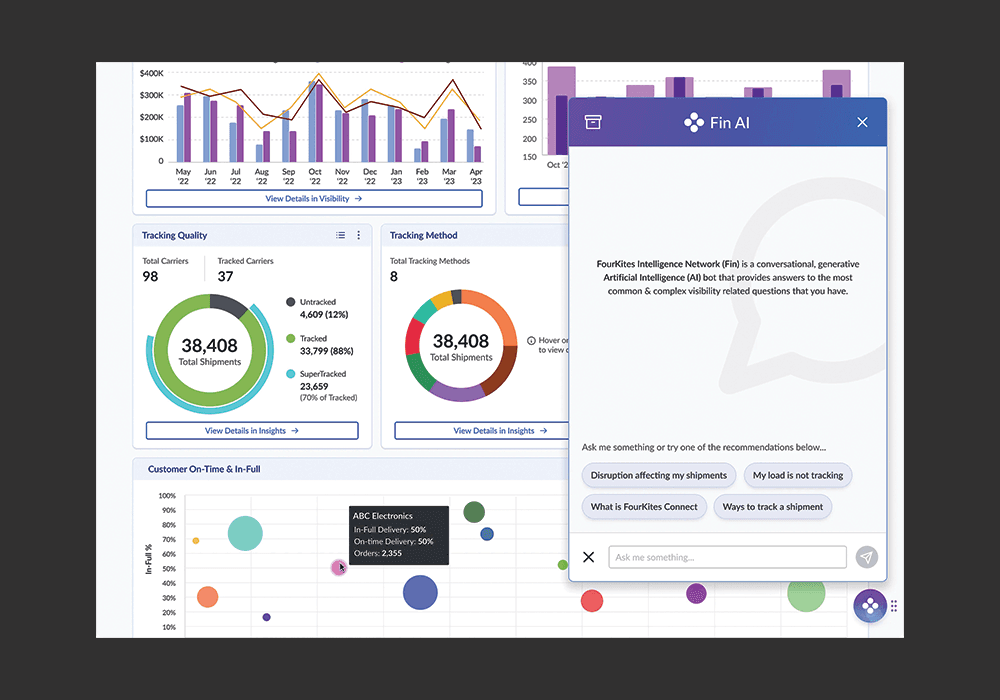
Fin AI launches as a contextual overlay, allowing operators to ask questions without leaving their current dashboard view.

Fin AI launches as a contextual overlay, allowing operators to ask questions without leaving their current dashboard view.

Fin AI launches as a contextual overlay, allowing operators to ask questions without leaving their current dashboard view.

Natural language input surfaces specific shipment recommendations, translating a complex multi-system query into a single actionable response.

Natural language input surfaces specific shipment recommendations, translating a complex multi-system query into a single actionable response.

Natural language input surfaces specific shipment recommendations, translating a complex multi-system query into a single actionable response.

AI-generated route recommendations include confidence scoring and cost impact.

AI-generated route recommendations include confidence scoring and cost impact.

AI-generated route recommendations include confidence scoring and cost impact.

Operators can generate custom dashboard widgets through conversation, reducing dependency on engineering for reporting configuration.

Operators can generate custom dashboard widgets through conversation, reducing dependency on engineering for reporting configuration.

Operators can generate custom dashboard widgets through conversation, reducing dependency on engineering for reporting configuration.

Fin AI generates a live widget preview, letting operators configure and add custom metrics to their dashboard without leaving the conversation.

Fin AI generates a live widget preview, letting operators configure and add custom metrics to their dashboard without leaving the conversation.

Fin AI generates a live widget preview, letting operators configure and add custom metrics to their dashboard without leaving the conversation.

Role-based executive view surfacing high-level KPIs, emissions data, and order performance across the full supply chain portfolio.

Role-based executive view surfacing high-level KPIs, emissions data, and order performance across the full supply chain portfolio.

Role-based executive view surfacing high-level KPIs, emissions data, and order performance across the full supply chain portfolio.

Proactive AI surfaces risk events on the map and immediately offers actionable recommendations, collapsing the time between alert and response

Proactive AI surfaces risk events on the map and immediately offers actionable recommendations, collapsing the time between alert and response

Proactive AI surfaces risk events on the map and immediately offers actionable recommendations, collapsing the time between alert and response

Human-in-the-loop checkpoint: AI identifies affected shipments and presents rerouting options, but the operator makes the final call.

Human-in-the-loop checkpoint: AI identifies affected shipments and presents rerouting options, but the operator makes the final call.

Human-in-the-loop checkpoint: AI identifies affected shipments and presents rerouting options, but the operator makes the final call.

Interaction architecture defining when AI acts autonomously versus when it escalates to a human, the core design challenge of the entire product.

Interaction architecture defining when AI acts autonomously versus when it escalates to a human, the core design challenge of the entire product.

The complete Fin AI ecosystem across contexts, showing how the conversational layer integrates consistently across product surfaces.

The complete Fin AI ecosystem across contexts, showing how the conversational layer integrates consistently across product surfaces.

Dark mode testing across contrast ratios and ADA compliance, validating accessibility standards across all UI states before shipping.

Dark mode testing across contrast ratios and ADA compliance, validating accessibility standards across all UI states before shipping.